The Missing Layer in Agent Systems: Semantic Boundaries, Not Bigger Context Windows
Memrail Team • December 5, 2025
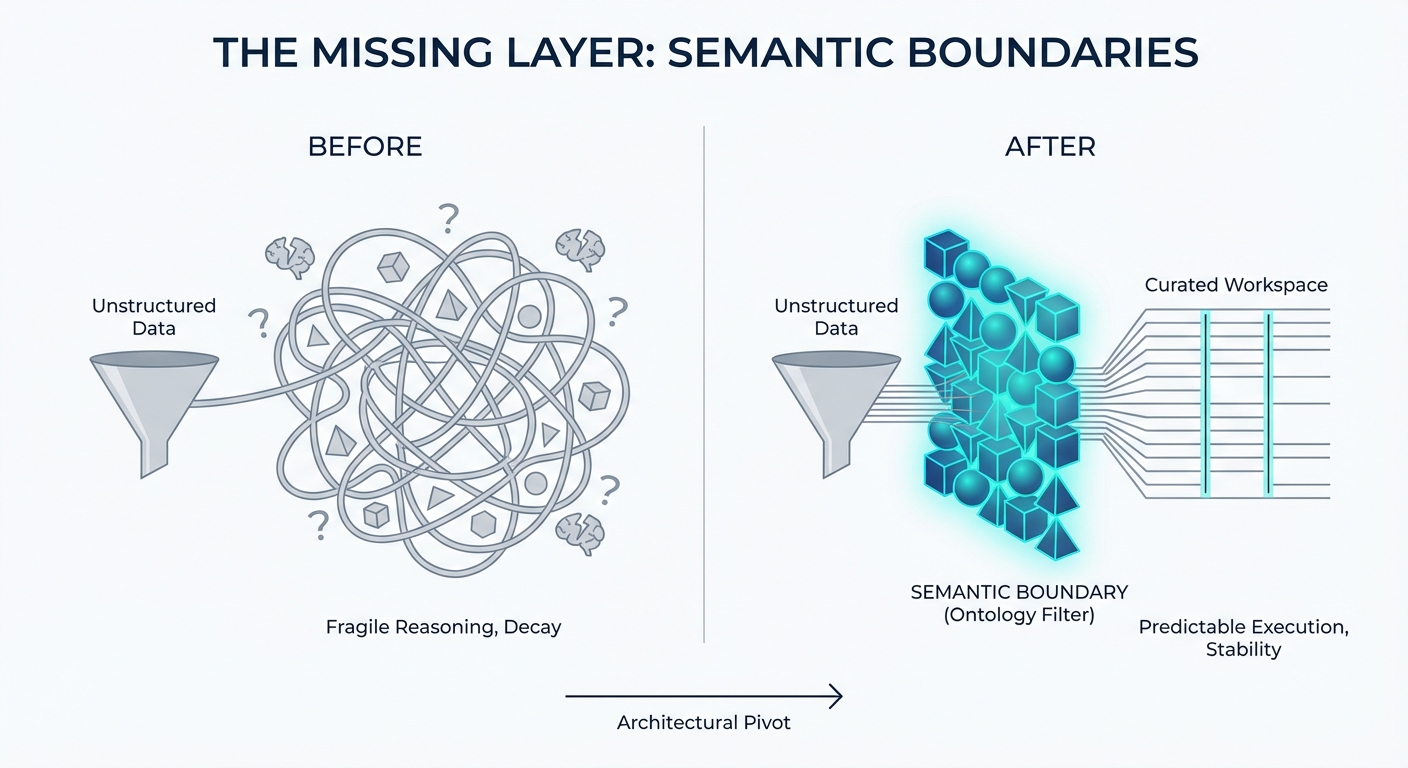
Teams scaling agent systems eventually run into the same problems: context gets bloated, decision quality decays, and performance becomes unpredictable as state grows.
These symptoms are widely attributed to token limits or retrieval inefficiencies. But the real problem sits deeper:
Agents treat all information as admissible.
If everything can enter context, then everything competes for attention — and the system must constantly compress, summarize, and prune in order to stay functional.
The result is fragile reasoning pipelines and inconsistent behavior that degrades with scale.
The missing piece isn’t more memory. It’s semantic boundaries.
Why Information Overload Happens
In most architectures, data flows into the agent in an unstructured way:
- logs
- documents
- tool outputs
- conversation history
- inferred attributes
All of it becomes text for the model to read.
And once text enters a flat context window, the agent loses the ability to distinguish:
- fact from instruction
- state from noise
- relevant from irrelevant
- transient from persistent
The underlying issue is not the size of the window. It’s the absence of type constraints.
Semantic Boundaries: The Architecturally Clean Solution
A scalable agent system must enforce rules about what counts as:
- a valid entity
- an allowed attribute
- a permissible relationship
- a meaningful memory fragment
- an actionable instruction
This is what an ontology provides: a finite, typed, rule-governed vocabulary for representing information.
But the value of an ontology isn’t in storing knowledge. It’s in policing the boundary of what can enter the agent’s reasoning space.
When every fact, tool, and memory update must match an explicit semantic category, then:
- irrelevant information is rejected by construction
- malformed state never contaminates context
- tools are filtered by role, not by name
- state transitions become predictable
- context remains sparse and structured, even at scale
This transforms context from a text buffer into a curated semantic workspace.
Search Is Not the Point
Teams often fixate on retrieval techniques: embeddings, search indices, RAG pipelines, graph stores, etc.
Those mechanisms help answer the question:
“Given a large corpus, how do we find the right piece?”
Semantic boundaries answer a different — and more fundamental — question:
“What should be allowed to appear at all?”
Once you enforce the latter, the former becomes dramatically simpler. When all information is pre-validated and typed, retrieval doesn’t require complex global search strategies.
You get relevance from constraints, not from algorithms.
That is the architectural pivot.
From “What Fits” to “What Belongs”
The essence of scalable agent memory is not compression. It is admissibility.
In Memrail’s execution model, every memory fragment, trigger, and tool output must satisfy structural rules before the agent can use it. Information that doesn’t conform simply fails validation and is never surfaced to the language model.
This changes the performance equation entirely:
- Context size stops driving complexity.
- Reasoning quality stabilizes under growth.
- Retrieval becomes local and cheap.
- Memory becomes deterministic instead of probabilistic.
The system stays coherent because the ontology governs what is meaningful.
Why This Matters for Agentic Behavior
When memory is filtered through semantic boundaries:
- Agents stop drowning in their own history.
- Tool calls become role-conditioned rather than heuristically chosen.
- State transitions align with domain rules automatically.
- Reasoning chains become reproducible instead of chaotic.
- Error surfaces shrink because invalid states never propagate.
This is the foundation of deterministic agents.
Not more context. Not more summarization. Not more vector search.
But structured meaning.
The Next Phase of Agent Architecture
Agents will not scale by expanding their windows or adding more retrieval pathways. They will scale by enforcing a principled structure on what they can know and how they can act.
Semantic boundaries create:
- predictable memory
- interpretable behavior
- efficient retrieval
- consistent execution
- stable tool interactions
- bounded long-term state
This is the core design principle underpinning Memrail.
Not “retrieve smarter.” Not “crop context better.”
But govern memory architecturally.