Integration Patterns
Three ways to integrate Memrail
Choose the pattern that matches your architecture. All three can coexist in the same system.
First-Class Decision Point
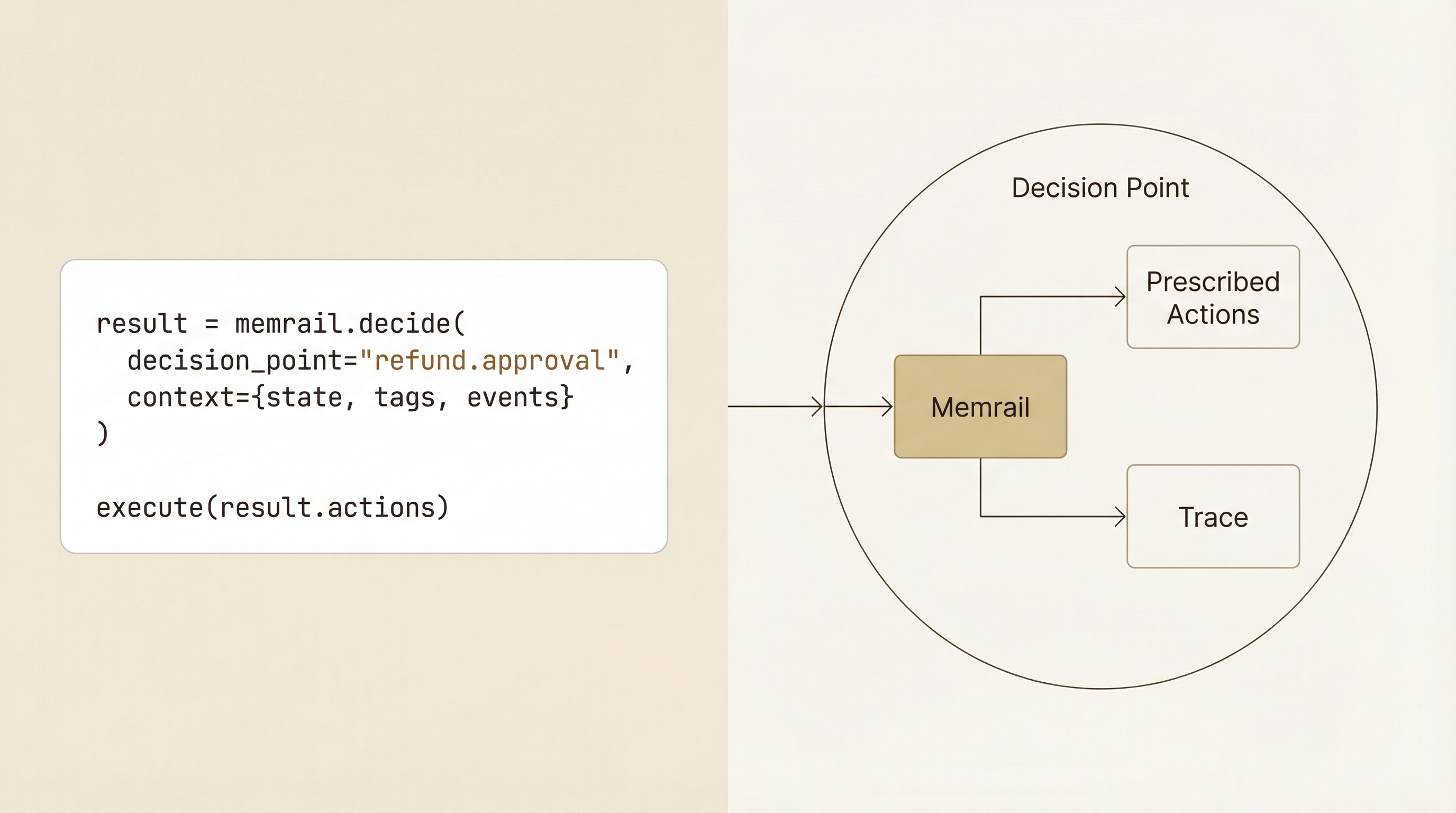
Surface key decision moments in your application as explicit, governed invoke points. Wherever your system asks “what should happen?”, Memrail evaluates context, applies your decision logic, and deterministically resolves the outcome before execution proceeds.
Decision points can live anywhere — inside service layers, workflow steps, background jobs, forecasting pipelines, or agent loops. You elevate consequential decisions into first-class artifacts, instead of leaving them scattered across prompts, conditionals, and hidden logic.
This is the most direct integration pattern: a single invoke call at any point where decisions matter.
Agent Loop Hook
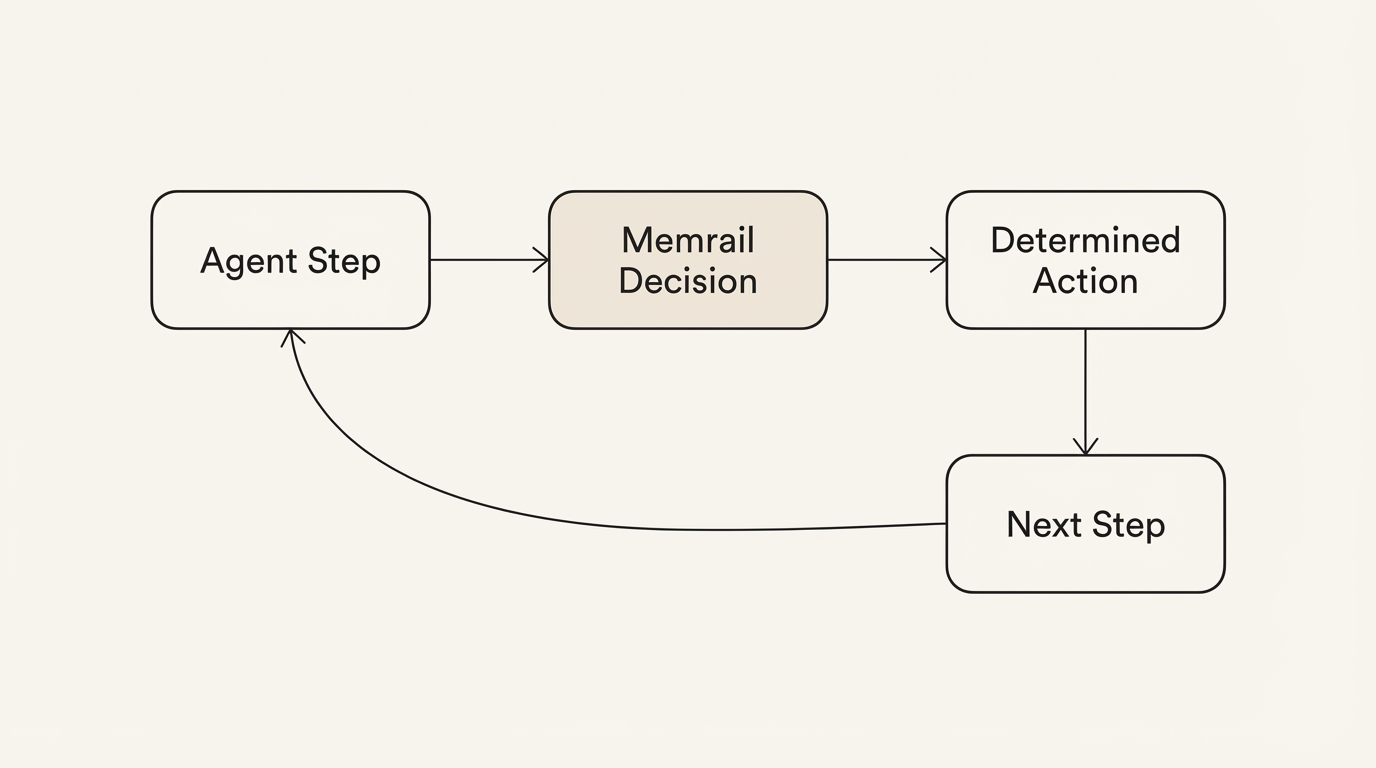
Invoke Memrail inside your agent's reasoning loop — at every step that is a decision point. Instead of allowing the agent to execute directly, Memrail receives the current context and selects the right action from your decision logic before execution proceeds.
At every iteration, Memrail receives the current context, deterministically resolves what should happen next, and returns prescribed actions with a full trace. The loop continues — but authority remains explicit and reproducible at each turn.
This pattern gives you fine-grained, step-level control over multi-step autonomous behavior without modifying the model itself.
Event-Driven
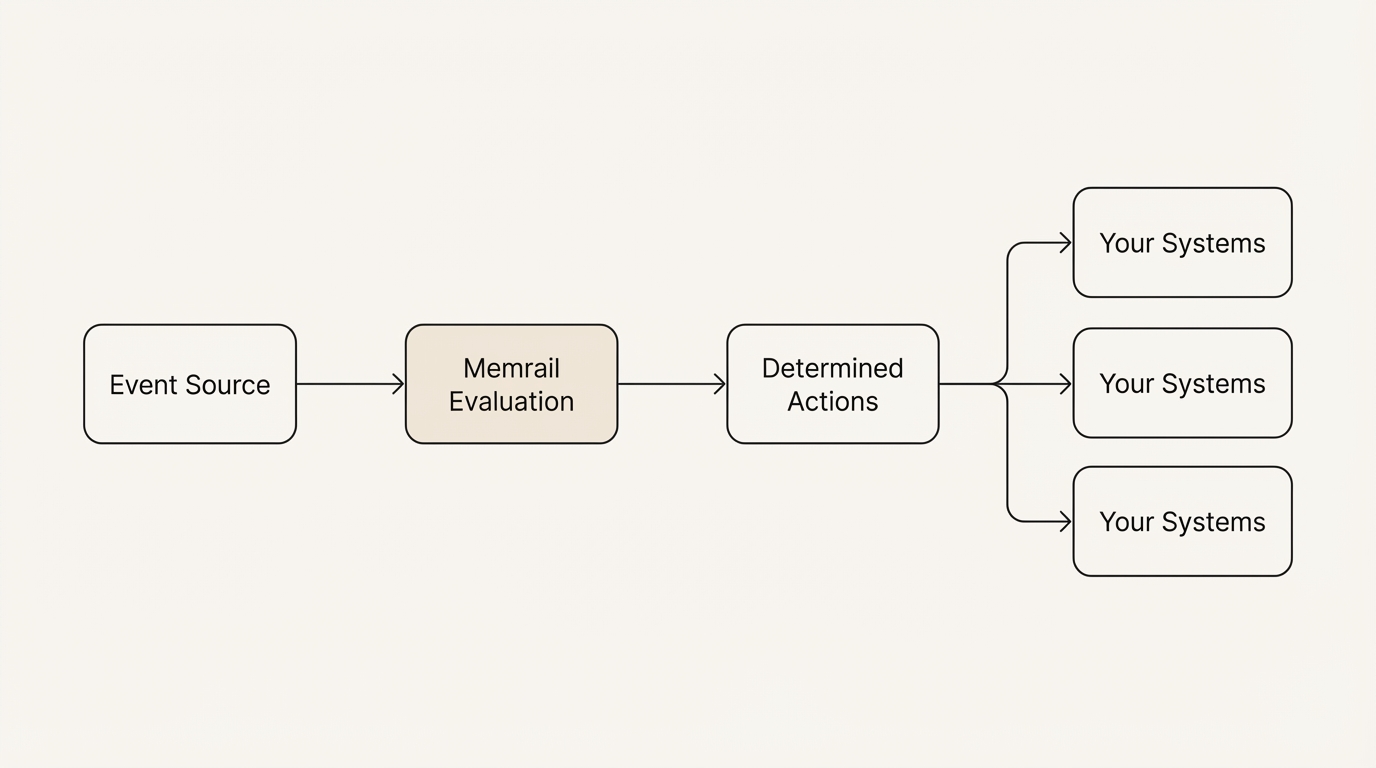
Attach Memrail to your event stream and evaluate decisions as state changes occur. When events are emitted — user actions, system signals, model outputs, or data updates — Memrail evaluates the structured context and deterministically resolves the appropriate response.
Rules fire asynchronously based on event patterns, triggering authorized actions, escalations, or workflow transitions. This pattern is ideal for reactive systems where timing, state, and history shape what should happen next.
Authority is not embedded in the event handler — it is resolved explicitly through the decision plane.