Know your rules can actually fire.

Static analysis that proves your governance is real - not theater. Know which rules work, which are broken, and exactly where the gaps are.

The Problem

Most governance operates on faith.

Most governance systems operate on faith: you define rules and hope they activate when needed. But if the required data isn't flowing, if the event isn't being emitted, or if no handler exists for the resulting action, the rule is theater. You have false confidence.

The Solution

Completeness you can measure.

Memrail makes integration completeness explicit. Every rule in the system can be statically analyzed to determine: can its trigger actually fire given the data your application provides? Can its action actually execute given the handlers you've built? Where are the gaps?

Two Dimensions

Trigger Reachability and Action Connectivity

Trigger Reachability

"Can this rule fire?"

  • Does the application provide the data this rule needs?
  • Are the events this rule references actually being emitted?
  • Are there rules that can never fire because their inputs don't exist?

Action Connectivity

"Can this action execute?"

  • Does a handler exist for this action type?
  • Is the target API or service connected?
  • Are there rules that fire correctly but whose actions go nowhere?

The Completeness Report

A concrete picture of your governance posture

A Memrail completeness analysis gives you concrete numbers: what percentage of rules are fully operational, how many rules are blocked by missing data inputs, how many actions are blocked by missing handlers, and specific gaps identified with remediation paths.

You don't discover gaps in production at 2 AM. You discover them in a report, before deployment, with a clear fix path.
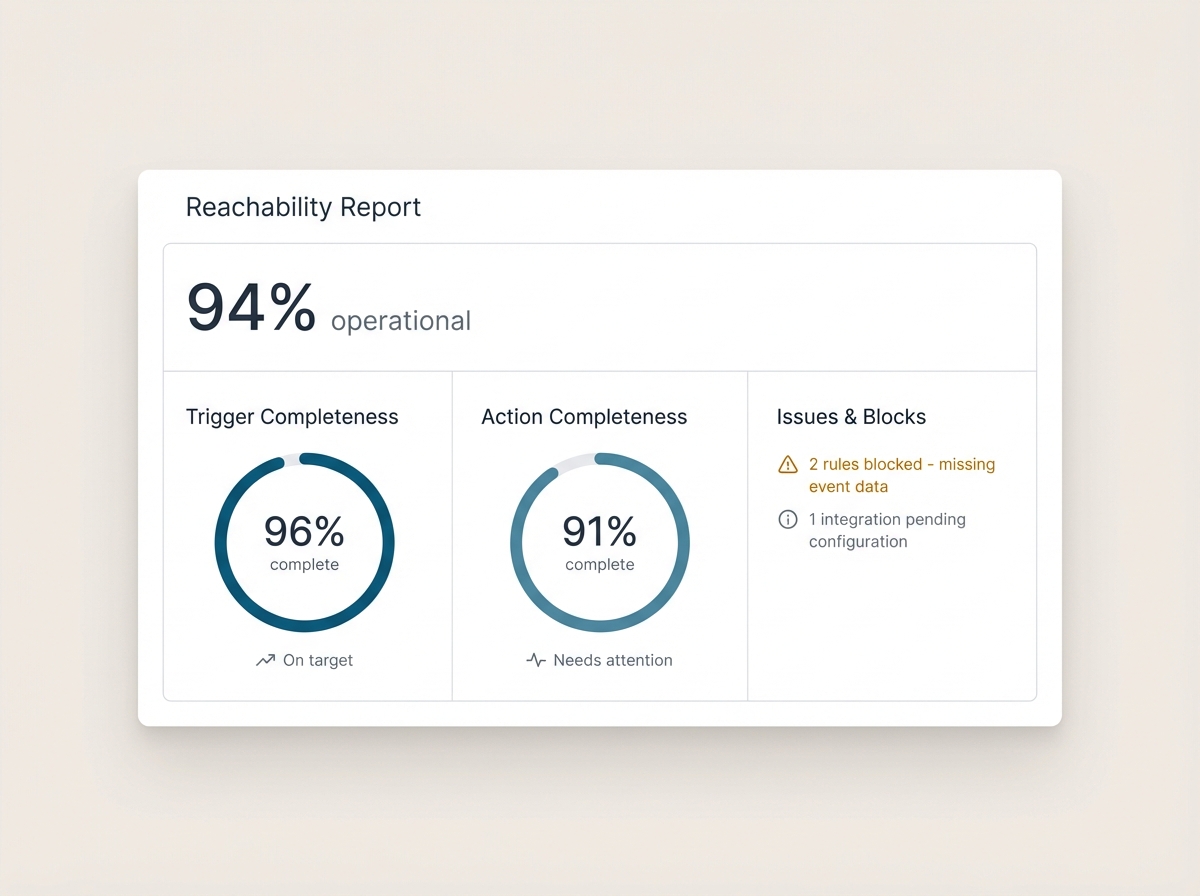
Completeness report showing trigger and action reachability

Why This Matters

From false confidence to verified governance

Pre-deployment verification

Know your governance posture before you ship, not after something breaks. Every gap identified with a clear remediation path.

No dead rules

Identify rules that look like they protect you but can never fire because the data they need doesn't exist in your pipeline.

No orphaned actions

Find rules that evaluate correctly but whose resulting actions have no connected handler - decisions that evaporate before execution.

Get a completeness report

In the 14-Day Pilot, we analyze your integration completeness - trigger reachability, action reachability, and specific gaps with remediation paths.

Start a Pilot

Questions

Frequently asked

Is completeness analysis done at deploy time or runtime?

Completeness analysis is a static analysis step that can run at any time - during development, before deployment, or as part of a regular audit. It examines the relationship between your rules, your data pipeline, and your action handlers without requiring live traffic.

What happens when a gap is found?

Each gap comes with a specific remediation path: which event needs to be emitted, which data field needs to be provided, or which handler needs to be connected. The report is actionable, not just informational.

How does this relate to the 14-Day Pilot?

The Pilot's Reachability Report is a completeness analysis applied to your selected workflow. It shows exactly which rules can fire, which can't, and what you'd need to connect to close the gaps.