Every rule goes through a structured promotion pipeline. Shadow, canary, active - with instant rollback at every stage.
The Problem
Changing autonomous behavior in production is terrifying. A new rule might fire when it shouldn't. A modified threshold might cascade into unexpected actions. Teams freeze, preferring known-bad behavior over unknown-different behavior.
The Lifecycle
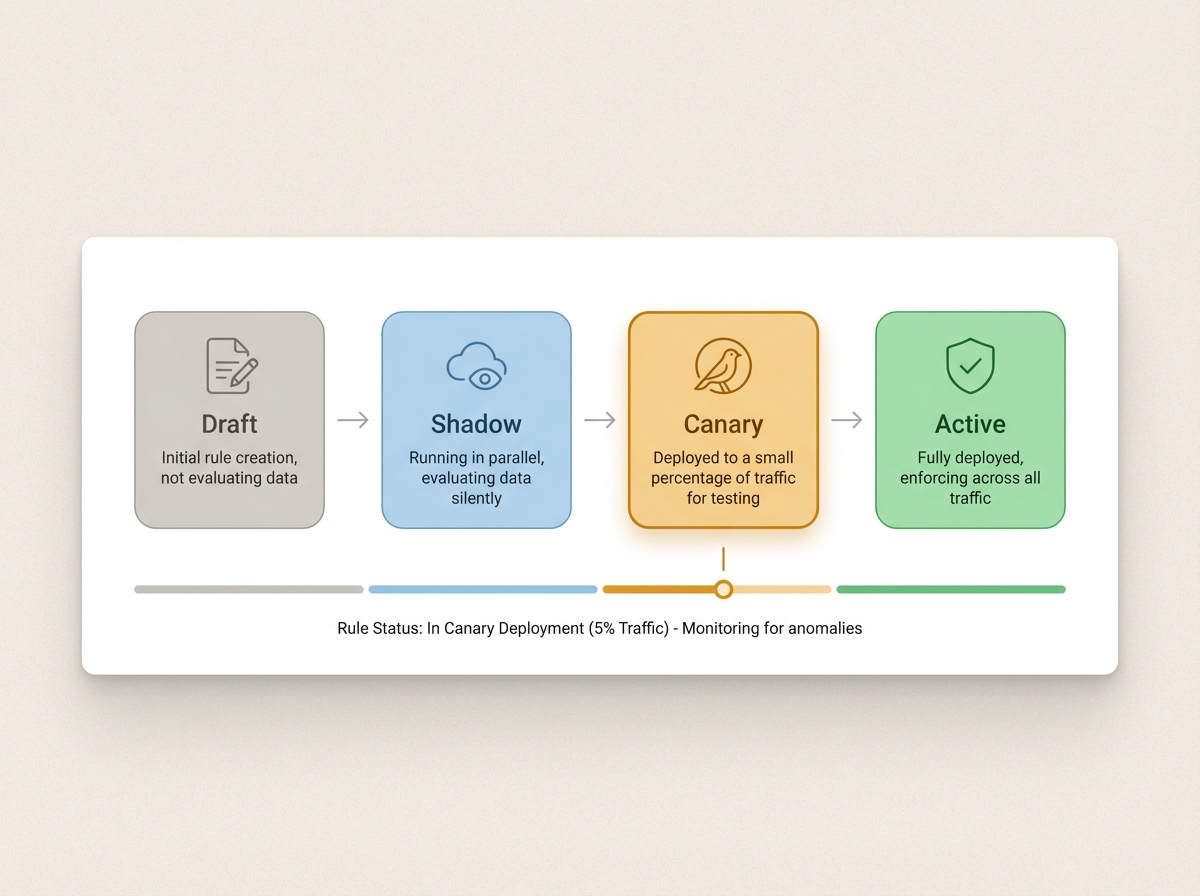
Every rule in Memrail goes through a structured promotion pipeline. New rules start silent, observing what they would do without executing. Then they execute for a small percentage of traffic. Only after validation do they go fully live.
Rules are authored and reviewed. Not yet evaluating against any traffic.
Evaluates against real traffic but never executes. Logs what would have happened. Compare against current production behavior.
Executes on a small percentage of traffic. Sticky routing ensures the same user gets a consistent experience. Metrics compared against existing rules.
Fully live in production. Validated through shadow and canary stages. Instant rollback available at any time.
For Teams
"Let me see what this rule would do on real traffic before I turn it on." Validate against production data without any risk of execution.
"Let me try this on 10% of traffic and compare outcomes." Gradual rollout with real metrics and real comparisons.
"Something unexpected? One command to deactivate." No deployments, no waiting, no cascading side effects. Instant reversion to previous behavior.
Define criteria that must be met before a rule advances to the next stage. Quality gates that enforce rigor without slowing teams down.
Autonomous behavior becomes a deployable, versionable, testable artifact - not a prayer.
Questions
It depends on your traffic volume and the rule's criticality. High-traffic workflows can validate in hours. Low-traffic or high-stakes rules might stay in shadow for days. The key is having enough data to compare shadow results against current production behavior with statistical confidence.
Rollback is instant. The rule returns to shadow mode or draft state immediately. Because canary rules only affect a small percentage of traffic with sticky routing, the blast radius is contained by design.
Yes. Each canary rule operates independently with its own traffic allocation and metrics. The system tracks interactions between concurrent canaries so you can measure combined effects and identify conflicts.