Centralized decision logic for consequential execution. Every action evaluated, every decision traceable, every outcome deterministic.
The Problem
Today, decision logic is scattered across prompts, if-statements, feature flags, ML models, and config files. When something goes wrong, reconstructing why requires archaeology across multiple systems. When something needs to change, the fear of side effects freezes teams.
The Solution
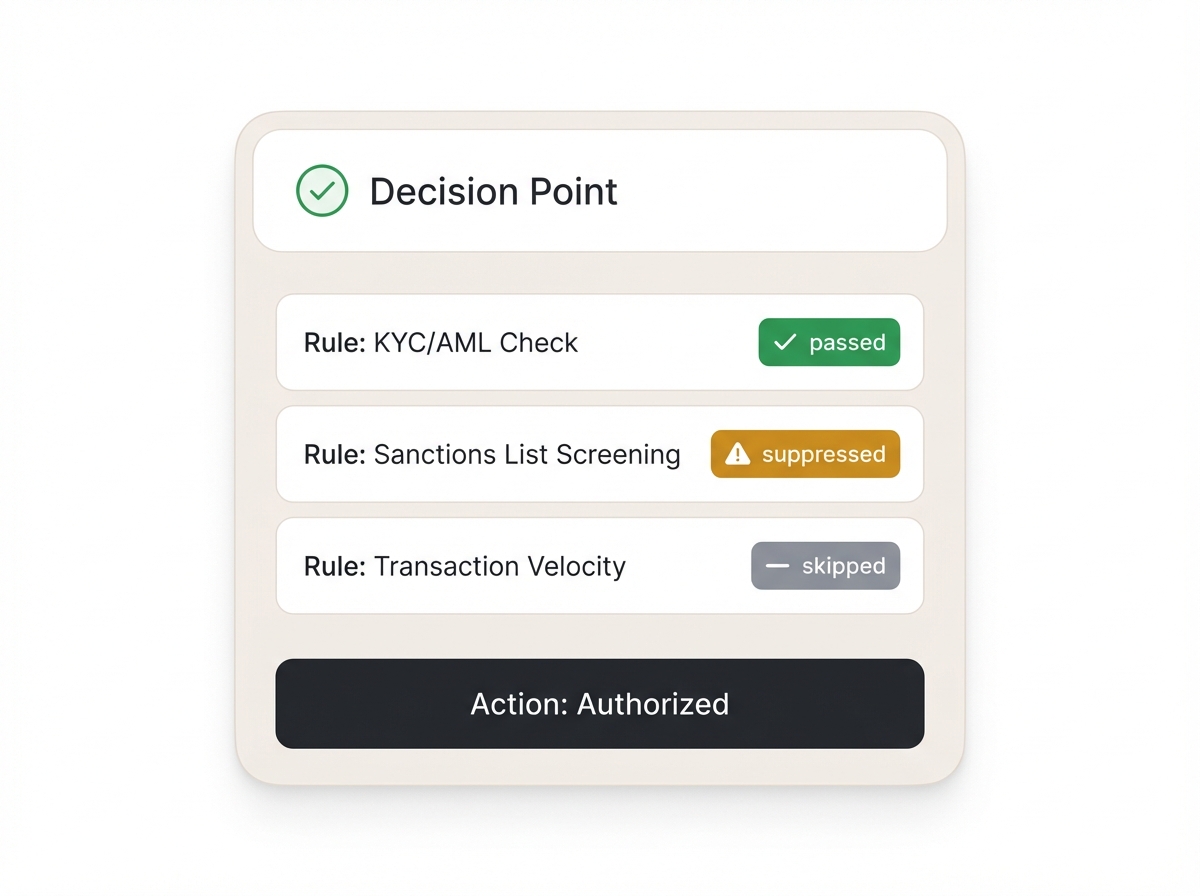
Memrail centralizes decision logic into a single decision plane. Your code defines decision points - where the system asks "what should happen?" Memrail evaluates all applicable rules against the current context and returns prescribed actions — with full rationale.
How It Works
In your application - API handlers, decision loop steps, event handlers, background jobs - wherever behavior should be governed.
At each decision point, pass the current state, tags, and recent events - the structured facts Memrail needs to evaluate.
All applicable rules are evaluated against that context. Deterministically. No randomness, no model inference, no probability.
Memrail returns the winning actions with scores, rationale, and a complete trace of what was considered and why.
Your code stays in control of execution. Memrail determines what should happen — your application decides how.
Key Properties
Same context plus same rules equals the same decision, every time. No variance, no drift, no surprises.
All decision logic visible in one registry. No more archaeology across prompts, configs, and feature flags.
System grows linearly with decision points, not exponentially with interactions. Complexity stays manageable.
Works with any LLM, any framework, any orchestrator. Swap models freely - the authority layer stays constant.
Decision Authority in Action
Decision logic scattered across prompts, if-statements, feature flags, and config files becomes a single, inspectable decision plane. Every rule visible. Every decision traceable. Every change governed.
Run a Decision Authority audit
Questions
Traditional rules engines evaluate conditions and fire actions. Memrail does that - plus it provides formal authority separation, deterministic replay, lifecycle management (shadow/canary/active), completeness analysis, and full decision traces. It is decision infrastructure, not just a rules engine.
Memrail's evaluation is deterministic and does not involve model inference. Rule evaluation is typically measured in single-digit milliseconds. This is orders of magnitude faster than the LLM calls that generate the proposed actions.
Yes. Rules start in shadow mode by default, evaluating against real traffic without executing any actions. You see exactly what would happen before you turn anything on. This is the recommended path for production adoption.