Decision authority for agents built with OpenAI's Agents SDK.
Integration Summary
Memrail adds deterministic governance to agents built with the OpenAI Agents SDK - ensuring every tool call, handoff, and action is validated against your business rules.
Every tool call your OpenAI agent proposes is validated against your policies before execution. Only authorized tool invocations reach your production systems.
Every decision in your agent's reasoning chain produces an audit-grade trace: what was considered, what was prescribed, what was suppressed, and why.
When agents hand off to other agents, Memrail governs the handoff against your policies. Context is preserved and every transition is governed and traced.
New governance rules start in shadow mode, observing what they would do on real agent traffic. Promote to canary, then active - with instant rollback at any point.
Reference Architecture
Your OpenAI Agent → Memrail Decision Plane → Your Production Systems
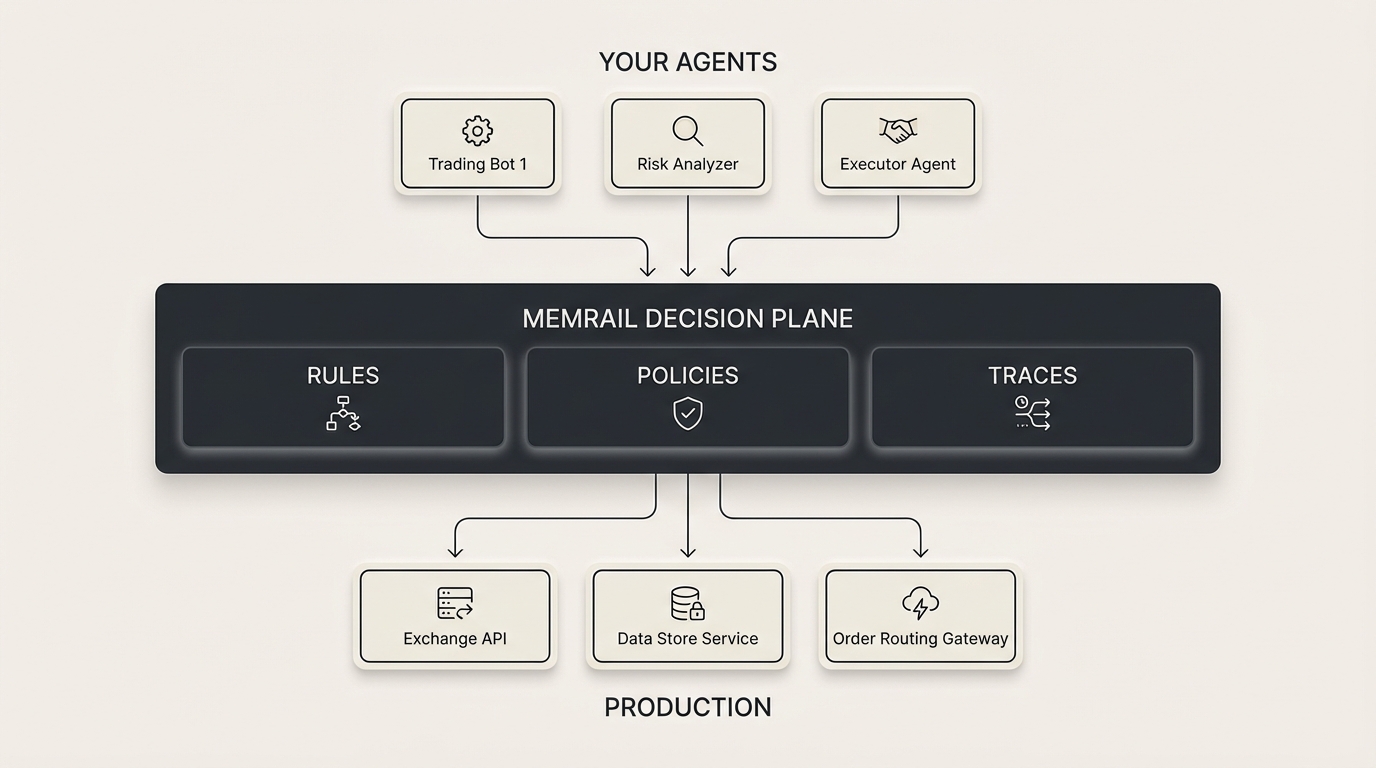
Memrail sits between your OpenAI agent's proposed actions and your production systems. At each decision point in the agent loop, Memrail validates the proposed tool call or action against your business rules - without modifying your agent code or OpenAI model configuration.
Integration Pattern
Map the decision points in your OpenAI agent workflow - tool calls, agent handoffs, data mutations, external API invocations, and reasoning checkpoints.
Place lightweight Memrail hooks at each decision point in your agent loop. These intercept proposed actions before they execute, sending context to the decision plane.
Supply the current agent state, conversation context, tool call parameters, and recent events. Memrail uses this structured context to evaluate all applicable rules.
The decision plane evaluates your business rules against the provided context and returns only the tool calls and actions that are authorized - with full rationale and trace.
Your OpenAI agent proceeds with only the prescribed tool calls and actions. Operations that don't match any active rule are suppressed or rerouted. A complete decision trace is logged automatically.
Common Workflows
Every tool call your agent proposes - database writes, API calls, file operations, email sends - is validated against your policies. Every tool invocation is governed by your rules.
Multi-step reasoning chains with checkpoints at each decision point. Memrail validates each step, preventing compounding errors and enforcing business constraints throughout the chain.
Every action your OpenAI agent takes produces a complete decision trace. Reconstruct any decision chain in seconds - what was proposed, what was prescribed, and why.
See It In Action
The best way to evaluate Memrail with your OpenAI agents is the 14-Day Decision Authority Pilot. We'll take your hardest agent workflow, map its decision points, run a controlled comparison of current vs. governed behavior, and deliver an integration roadmap.
Questions
Your OpenAI agent code, model API calls, and tools run in your environment. Memrail can be deployed in your cloud, as a managed service, or in a hybrid model. Your agent calls Memrail at decision points and receives authorized actions back. Model weights and raw data stay in your environment.
Memrail receives the context you provide at each decision point: agent state, tool call parameters, tags, and events. It does not access your OpenAI API keys, model configurations, or conversation history beyond what you explicitly provide. It stores decision traces and rule definitions.
Minimal changes. You add Memrail invoke hooks at your decision points - typically before tool execution and at agent handoff points. Your existing agent logic, prompts, and tool definitions remain unchanged. Memrail adds governance alongside your existing code.
Memrail's deterministic evaluation runs in single-digit milliseconds. For OpenAI agent workflows where model inference calls take hundreds of milliseconds to seconds, Memrail's overhead is negligible. The governance check happens between the model's response and tool execution.