Diagram
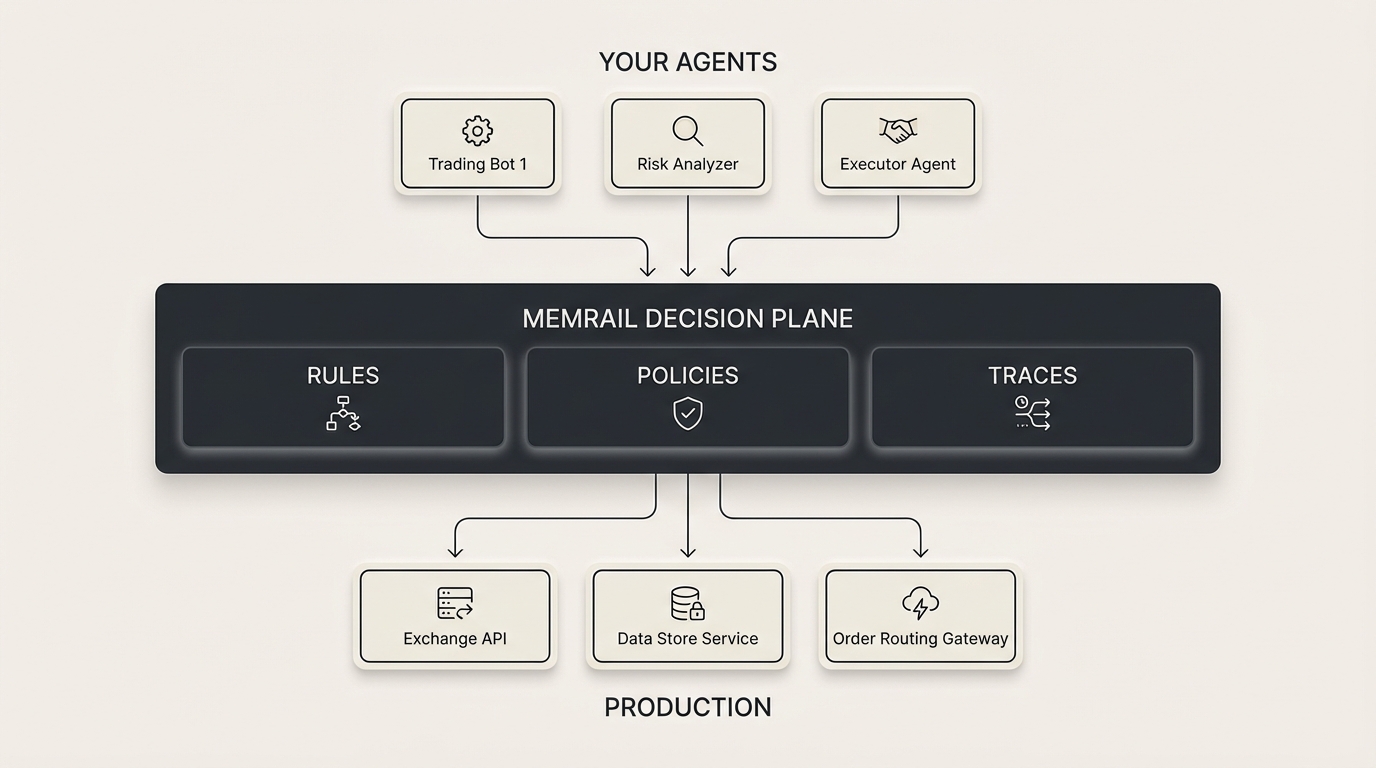
The decision plane in context
Memrail sits between intent and execution. At each decision point, the decision plane receives context and selects the right action from policy, with a full decision trace.
The architectural framework underlying Memrail. A formal separation between observation, memory, and authority that makes AI decisions deterministic and reproducible.
The Framework
SOMA introduces a formal separation between observation, memory, and authority. This separation means that no matter which LLM generates a proposal, no matter which orchestrator coordinates the workflow, the authority layer makes the same decision given the same context.
Structured facts about the world. Typed atoms: state (current values), tags (classifications), and events (timestamped occurrences). The raw inputs to every decision.
Rules encoded as executable units with explicit triggers, actions, and policies. Not neural memory - structured, versioned, inspectable memory that fires deterministically when conditions are met.
Deterministic evaluation, arbitration, and resolution - independent of the model. The authority layer receives context, matches it against policy, and selects the binding action.
Properties
Rules are pure functions. Given documented inputs, they produce predictable outputs. No hidden state, no side channels, no emergent behavior from interaction effects.
Same inputs plus same rule versions plus same timestamp equals identical output. Every time. This is what makes decision traces audit-grade.
The execution layer has no generative component. It evaluates, it does not hallucinate. It selects from defined options, it does not invent new ones.
Versioning, lifecycle management, and promotion gates are architectural features, not add-ons. Every change is governed by the same rigor as the decisions themselves.
Diagram
Memrail sits between intent and execution. At each decision point, the decision plane receives context and selects the right action from policy, with a full decision trace.
Research
For the formal treatment of SOMA architecture, request access to our research preprint. The paper covers the theoretical foundations, formal properties, and proofs underlying Memrail's deterministic authority model.
Questions
SOMA is an architectural framework developed by Memrail. The conceptual model is public. The formal treatment is available in our research preprint (request access above). Implementation details are proprietary.
Most agent frameworks handle orchestration - coordinating which agent does what and when. SOMA addresses authority - ensuring that at each decision point, the right action is selected from policy given the current context. They are complementary layers, not competing approaches.
No. SOMA's authority layer is model-independent by design. It works with any LLM, any agent framework, and any orchestrator. The formal separation between observation, memory, and authority means the evaluation layer has no dependency on the proposal layer.